Dustimony™ User Guide

For Dustimony on iPhone

Dustimony runs a cleaning business from your pocket: who you clean for, what gets done in each house, and what you are owed. Your book works with no signal, so a basement with no bars never stops your day. This guide walks the app the way you walk a work day.

Your clients never install anything. Texts come from your own phone number, and invoices arrive as normal PDFs. If you switch on card payments, they tap a link and pay on Stripe's secure page. To them it is just you, organized.

1. Get your clients in

Open the Clients tab and tap +. Add one client by hand, with their address and schedule on a single screen, or bring your whole list at once.

Give a client a schedule (weekly, every two weeks, or monthly) and the coming weeks fill in by themselves. The list shows each client's cadence and what they owe, and the filters at the top split it into Active, Leads and Past due.
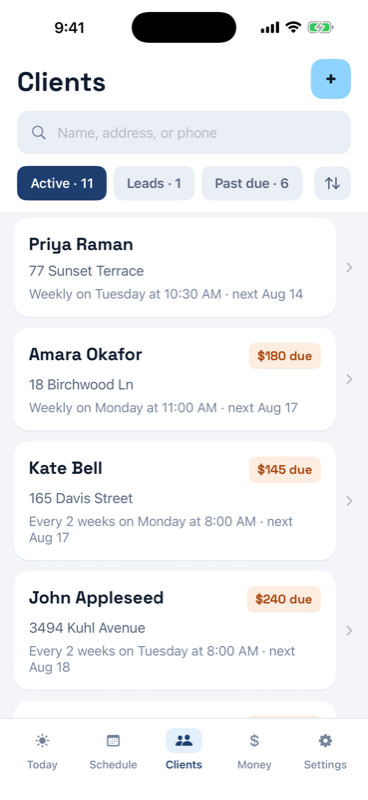
The clients list
Cadence and balance on every row, with Active, Leads and Past due as filters.

2. Your prices

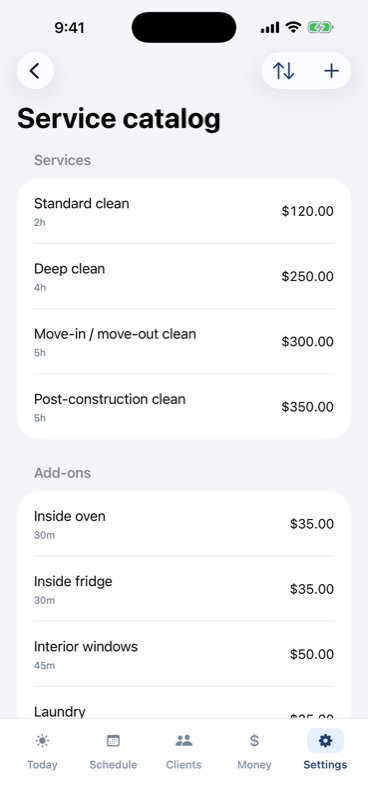
Settings → Service catalog is your price list. It arrives filled in with the jobs most cleaners sell: standard, deep, move-in/move-out and post-construction, with a set of add-ons underneath. Every one is yours to rename, reprice or delete.

Two things read from this list. A new booking offers these services at these prices, and the add-ons become the chips you tap when you finish a job. Change a price here and future work uses it; work already completed keeps the price it was done at, because that number is history, not a setting.

Service catalog
Services and add-ons, each with a price and how long it usually takes.

3. Run your day

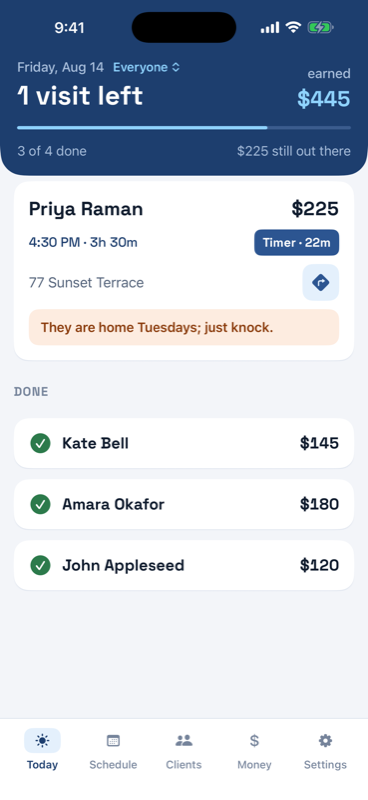
The Today tab is the working screen. Your stops are in time order with the address, the access note, and a directions button that opens Maps. The header counts what is left and what you have earned so far.

Tap Timer to start the clock when you walk in. If you forget to start it, or forget to stop it, you can type the real minutes at completion. The app never invents a number for you.

Running behind? Dustimony offers to text the clients who are still waiting, one message each, from your number. You tap send.

The Today tab
What is left, what is done, and what today has earned.

4. At the house

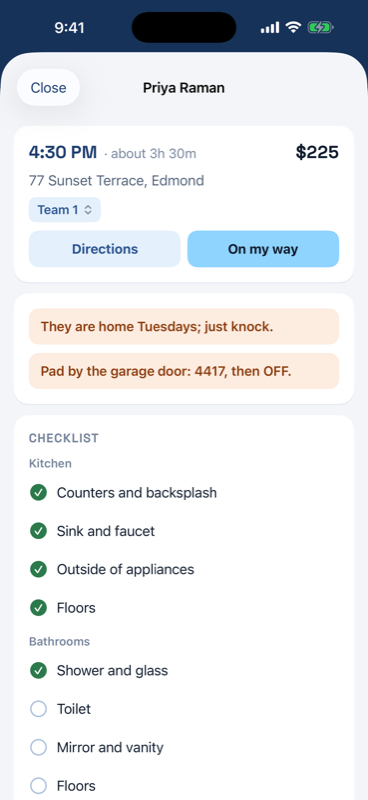
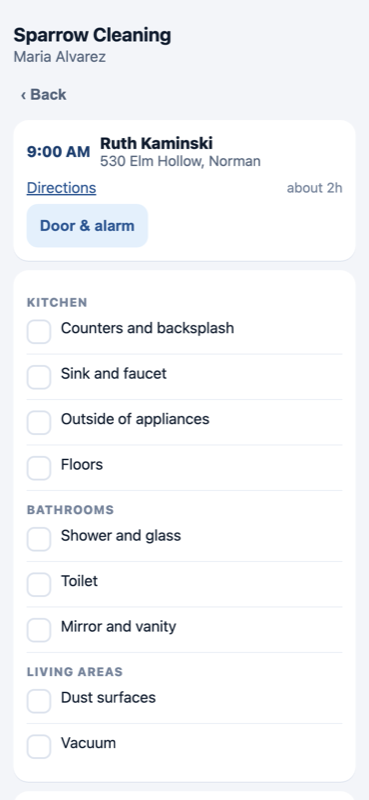
Tap a stop to open it. This is the screen you work from: how to get in, and what the client expects done.

Door codes, key locations and alarm details are private. They live in your own iCloud, they are never written to a log, and they never leave the device unless you send them.

A visit with its room checklist
Access notes at the top, the room-by-room list underneath.

5. Complete a job

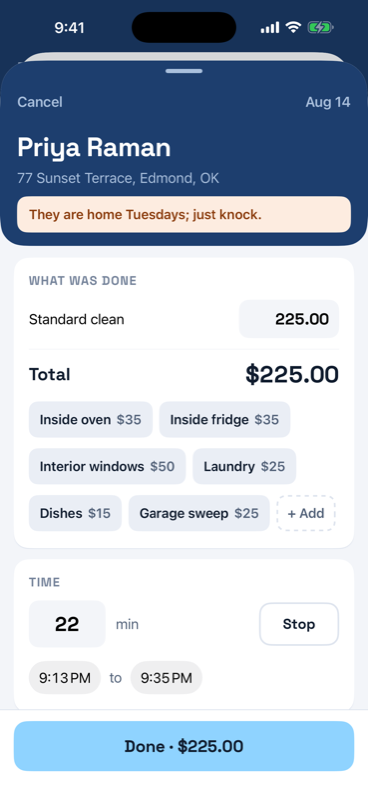
Complete opens the sheet where the job becomes money. The price is already filled in from the booking. Tap a chip to add an extra. The price on the chip is the one from your catalog, and the total moves as you tap.

The time is whatever the timer recorded, and you can correct it by typing the minutes or the start and end times. Notes are for the thing the word "notes" cannot say: the key that would not turn, the room you could not reach.

Done records the charge against the client. Nothing is sent to anyone at this point; the money side is yours to run when you choose.

The completion sheet
Prefilled price, add-on chips, and the time the job actually took.

6. The week

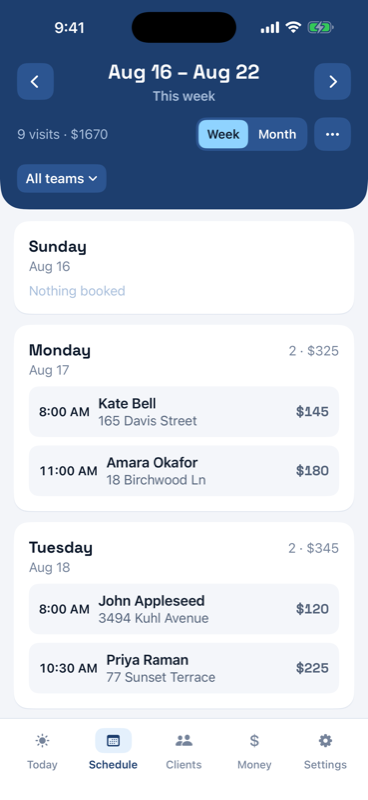
The Schedule tab shows the week a day at a time, with each day's count and what it is worth. Switch to Month for the shape of the month, where a dot marks a booked day.

Move a visit and the app asks whether you mean this one or the whole series. Take a holiday or a slow week off and those days clear for everyone, with the bookings picking up on the other side.

To end a booking that repeats, open it from the client's page and tap End booking; visits already done stay in the history. A one-time booking is deleted from the visit itself: open it and tap Delete booking.

If a booking ever collides with another, the row says so with a warning, before you drive to it.

The week planner
Nine visits and what the week is worth, two per day.

7. Text your clients

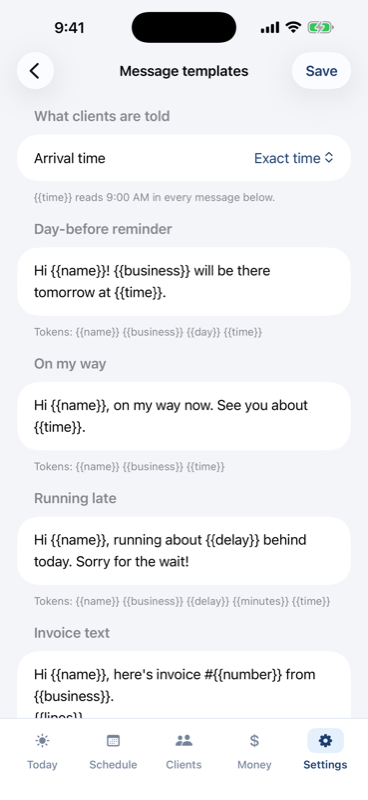
Settings → Message templates holds every message Dustimony writes: the day-before reminder, on my way, running late, the invoice text, and the three payment reminders. Tokens like {{name}} and {{time}} fill themselves in.

Arrival time decides what a client is told. Exact time sends "9:00 AM". An arrival window sends "between 9:00 and 11:00", which is a promise you can keep on a day that runs long. Your own screens always show the exact time.

Every message opens in your phone's Messages app with the text already written. Nothing is ever sent automatically, and it comes from your number, not ours.

Message templates
Each message is yours to rewrite. The tokens fill themselves in.

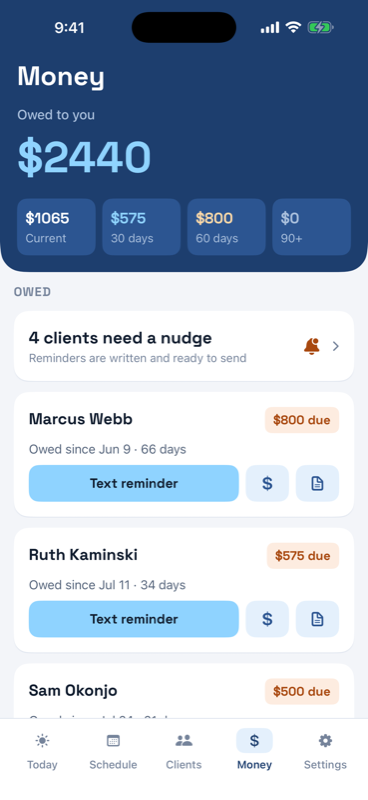
The Money tab opens on what you are owed, split by how old it is. Anything past thirty days is worth a nudge, and the reminder is already written.

Record cash, a check, Venmo, Zelle, Apple Pay or a card payment against a client in two taps. The balance updates as you do.

The Money tab
Owed to you, aged, and who to nudge first.

Invoices

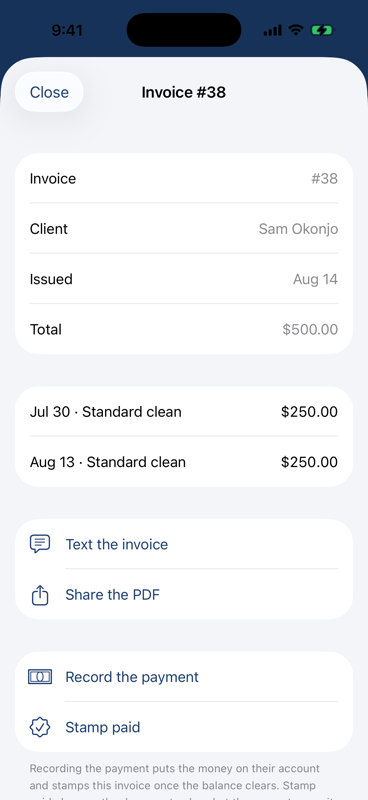
An invoice gathers completed visits into one document. Send it as a text or share the PDF; both carry the same line items, and both carry a pay link if you have card payments switched on. An issued invoice never rewrites itself. Change a price afterwards and the ledger changes, while the document you already sent stays as it was.

When the money arrives, record the payment: it goes on the client's account and stamps the invoice once the balance clears. Stamp paid is there for the invoice you issue after cash already changed hands; it changes the document only, so what they owe stays as it is. If you issued one in error, void it: the charges go back to being billable, and the sales tax the invoice added comes back off.

An invoice
Text it or share the PDF. The pay link works until it is paid.

Card payments

Card payments are optional and use Stripe. You connect your own free Stripe account, money lands in your bank, and Dustimony never sees a card number. Cards cost about 3.4% plus 30¢ per payment, which is Stripe's cut plus 0.5% to Dustimony. Cash and checks you record yourself cost nothing, and the app is free to use on your own.

9. Know your numbers

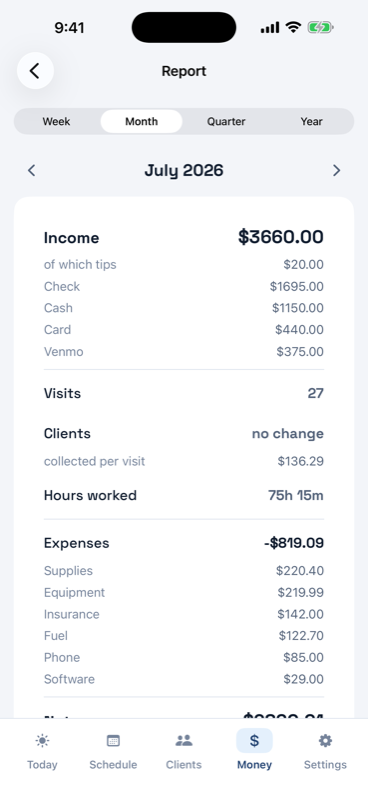
Money → Report answers what a week, a month, a quarter or a year actually did. Income is what you were paid, not what you billed, and the report says so on the screen. Under it: visits, hours worked, clients gained and lost, what came in by payment method, and what went out by category.

Page back with the arrows. Share it as a file when your accountant asks.

The monthly report
July, paged back: income by method, hours worked, expenses ranked.

Expenses

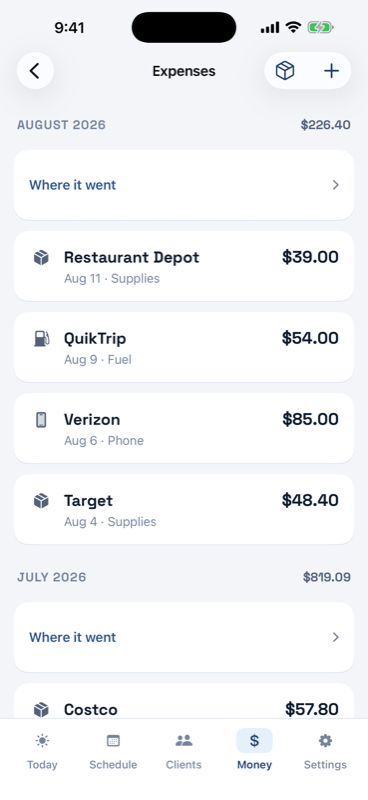
Log anything the business spends, from supplies and fuel to equipment and insurance, with a vendor and an optional photo of the receipt. Where it went ranks the month by category, which is usually enough to see the leak.

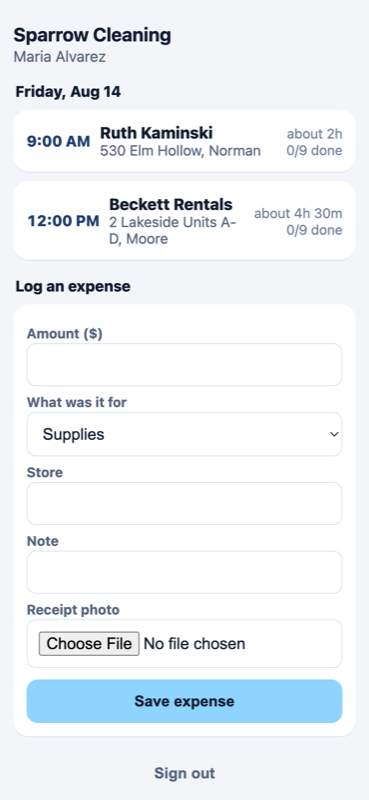
If you run crew, they can log expenses from their phones and the receipt photo comes back to you.

Expenses
By month, with the category on every row.

10. Know your clients

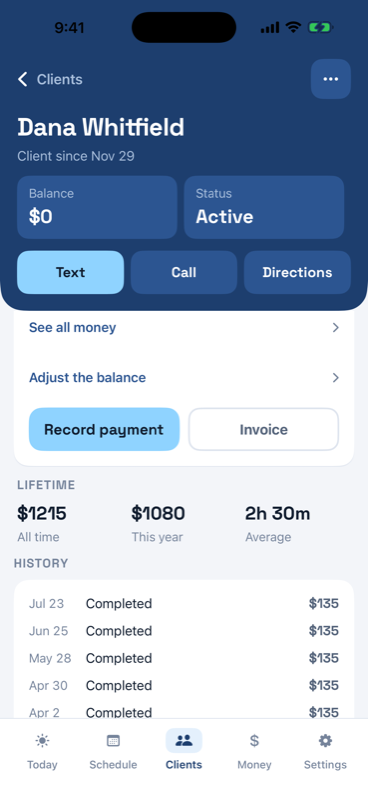
A client's page carries their balance, their status, and one-tap text, call and directions. Underneath: what they have been worth all time and this year, their average visit length, and every visit you have ever done for them.

Mark a client paused for the season, or lost with the reason why. The reason is kept on the record, so the win-back list later is a list of facts rather than a guess.

A client page
Lifetime value, this year, average length, and the full history.

11. Your crew

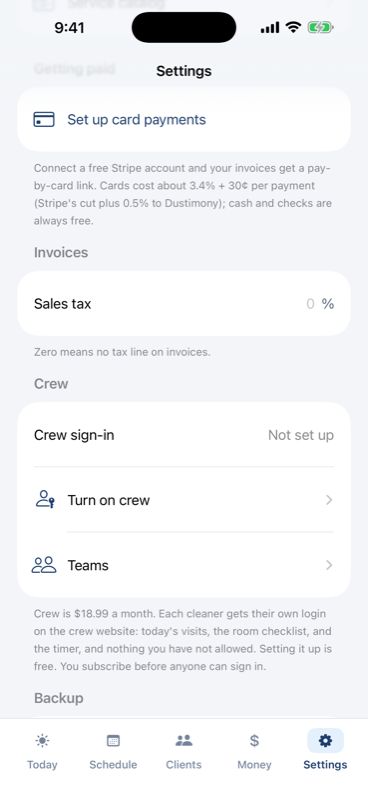
Crew is a subscription, $18.99 a month. Setting it up is free; you subscribe before anyone can sign in. It gives each cleaner a login on a website, with no app to install and no account for them to create.

Settings → Turn on crew creates your business code and adds your first cleaner with a name and a PIN. You choose what each person can see:

Anything a person is not allowed to see is never sent to the server in the first place, rather than hidden on the page.

Crew settings
Crew sign-in state, teams, and what the subscription covers.

What your cleaner sees

They open the crew website on their phone and sign in with the business code, their name and their PIN. No app, no password to reset, and it works on Android and iPhone alike. The page is in English or Spanish, their choice, on the sign-in screen.

Their day is a list of stops. Tapping one opens the room checklist, the timer, and, if you allowed it, the door code behind a button, so it is not sitting on screen in someone's hand at the supermarket.

What they tick, the time they log and the expenses they enter come back to you, and the rooms you check on your own phone show up on their screen with your name on them, so nobody cleans a room twice.

The crew website, a day
A cleaner's day: their stops, and a place to log an expense.
The crew website, one stop
One stop: how to get in, and the room checklist.

Teams and the roster

Two vans, two routes. Make a team in Settings → Teams, then use the team filter on the Schedule tab to see one team's week at a time. Roster, in that same filter menu, is where you set who rides with which team on which day. That changes weekly, so it lives with the schedule rather than in Settings.

12. Your business, your data

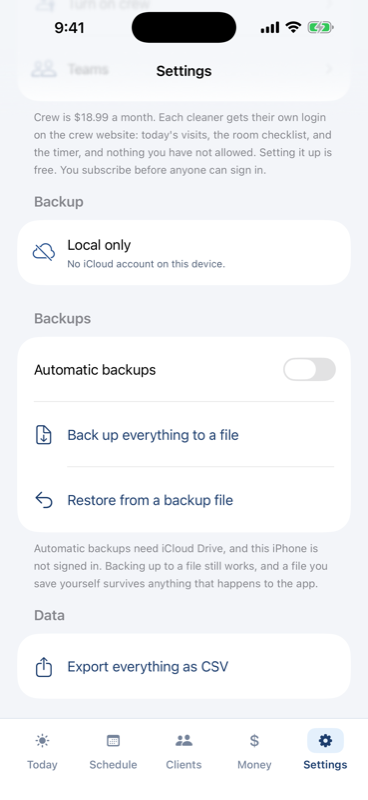
Everything is stored on your iPhone and synced through your own private iCloud, which we cannot read. Two devices signed into the same Apple account stay in step. With no iCloud account the app still works completely; it just stays on the one phone, and the Settings screen says so plainly rather than pretending.

Automatic backups write a full copy to your iCloud Drive. Back up everything to a file saves one anywhere you like, and a file you saved yourself survives anything that happens to the app. Export everything as CSV hands your clients and history to a spreadsheet, because it is your business and it should be portable.

Backups and data
Backups, restore, and a CSV export of everything.

Questions or problems

Email dustimony@loboz.com and a person will answer. The support page has the common questions, and the privacy policy spells out exactly what is stored and where.